Why comparison feels automatic, and how to change the pattern.
I was having breakfast with some friends this week when the conversation turned to comparison.
We found ourselves talking about what others have accomplished lately. And then, almost without meaning to, reflecting on what we’d accomplished.
And it reminded me of something from Shawn Achor’s The Happiness Advantage.
He describes what happens at Harvard University each September. They accept roughly the top 1% of students, young people who’ve spent their school years being the best at everything.
Then they arrive on campus. And suddenly, 99% of them are no longer in the top 1%.
The reference group has shifted. And with it, their entire sense of who they are.
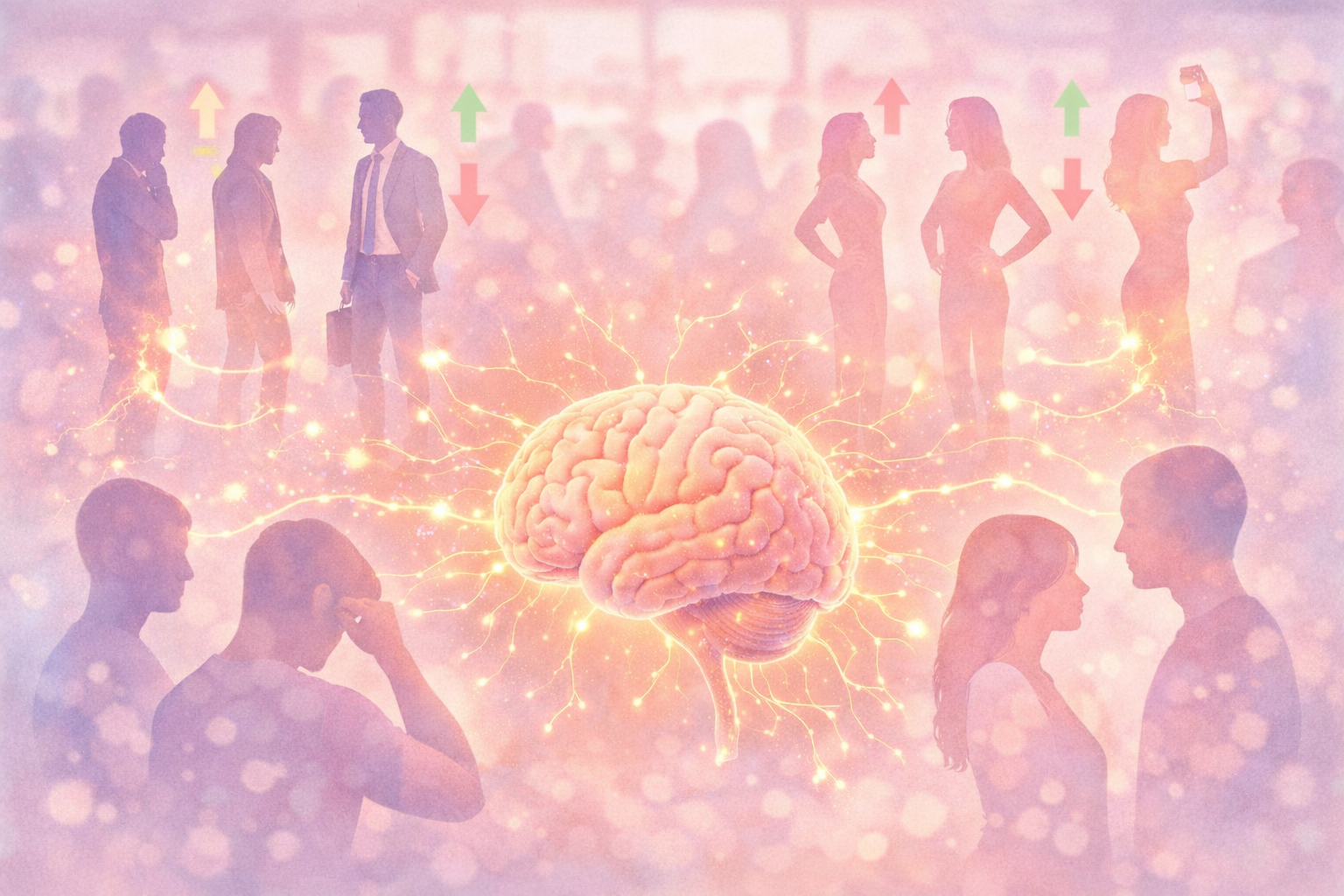
It made me wonder: what actually happens in the brain when we compare ourselves to others? And why does falling into this trap have such a big impact on our mental health?
The Brain is Wired for Social Comparison
Comparison is a feature of being human.
Our brains are deeply social. We have entire neural networks dedicated to understanding where we stand in relation to others, what neuroscientists call “social cognition.”
From an evolutionary perspective, this made sense. Knowing your place in the group helped you survive. It told you who to learn from, who to compete with, who to trust.
But in the modern world, where our “group” includes thousands of curated highlight reels on social media, this ancient wiring can work against us.
What Happens in the Brain During Comparison
When you compare yourself to someone else, several brain regions activate:
- The medial prefrontal cortex (mPFC) activates up when we think about ourselves in relation to others. It’s constantly asking: Am I doing better or worse than them?
- The ventral striatum (part of the reward system) responds differently depending on the outcome of that comparison. When we compare favourably, we get a dopamine hit. When we compare unfavourably, reward activation drops and we feel diminished.
- The anterior cingulate cortex (ACC) detects the conflict between where we are and where we think we “should” be. This is the region involved in emotional pain. Social comparison, especially upward comparison, can genuinely hurt.
Important to Note: The more we engage in comparison, the stronger these pathways become. It becomes a habit loop. A default way of evaluating our lives.
The Reference Group Effect
What the Harvard example shows us is that comparison is always relative.
You could be objectively accomplished, talented, and growing but if everyone around you is too, your brain recalibrates.
This is called the reference group effect. We don’t evaluate ourselves against an absolute standard. We evaluate ourselves against the people we see most often.
This is why:
- A promotion can feel disappointing if your colleague got a bigger one
- A creative project can feel small if a peer’s went viral
- Your progress can feel slow if someone else’s looks effortless
The brain isn’t asking, “Am I doing well?” It’s asking, “Am I doing well compared to them?”
And depending on who “them” is, the answer will always shift.
The Cost of Chronic Comparison
When comparison becomes chronic, it doesn’t just feel uncomfortable, it has real biological and psychological effects:
- Increased cortisol (the stress hormone) as the brain perceives social threat
- Reduced self-efficacy (belief in your own abilities)
- Decreased motivation because effort feels pointless if you’re “behind”
- Heightened anxiety and depressive symptoms as the gap between self and other feels insurmountable
You start seeing your life through a lens of lack.
Not because your life is lacking, but because the lens itself is designed to find gaps.
Three Ways to Recalibrate Your Social Brain
- Curate your reference group consciously. Your brain will compare. So give it a context that serves you. This might mean:
- Limiting exposure to certain social media accounts
- Spending time with people who are a few steps ahead, not miles ahead
- Seeking out communities where different forms of success are celebrated
Ask yourself: Is this reference group helping me grow, or just making me feel small?
- Shift from upward comparison to lateral learning. Instead of “Why don’t I have what they have?” try: “What can I learn from their path?” This activates different neural pathways, ones associated with curiosity and growth rather than threat and deficit. The brain moves from: I’m not enough → I’m learning
- Practice downward gratitude. Research shows that reflecting on how far you’ve come, compared to an earlier version of yourself, activates reward and self-compassion circuits. Not in a “at least I’m not them” way, but in a “look how much I’ve grown” way. Try this: Write down three things you can do now that you couldn’t do a year ago. Not achievements. Just capacities. Skills. Understandings. Your brain needs evidence of progress that isn’t tied to someone else’s timeline.
Coaching Reflection
The real shift happens when we stop asking: Am I as good as them?
And start asking: Am I becoming who I want to be?
One question makes you feel small.
The other helps you to grow.
I hope you enjoyed this article. Share it with anyone you feel may benefit.
Until next time,
Safiya
Want to explore this one-to-one?
Book a 30-minute chemistry call to see whether coaching is right for you, or get new articles straight to your inbox.