The quiet shifts and seasons of life.
When I started my Master’s, I never anticipated the quiet shift my life would take. The gradual fading of things I used to pour myself into.
Social plans I stopped making.
Friendships I showed up to less.
A version of myself that had more space, more spontaneity, more capacity.
That version didn’t disappear, she just stepped back, because something new had arrived and needed almost everything I had.
It was during one of those catch-up calls with my mum, that she mentioned a theory. Four burners, she said. Family. Friends. Health. Work. And the idea that to truly succeed, you have to turn one off. Maybe two.
I sat with that for a while. Because it felt true. But it also felt like it was missing something…
The Four Burners Theory
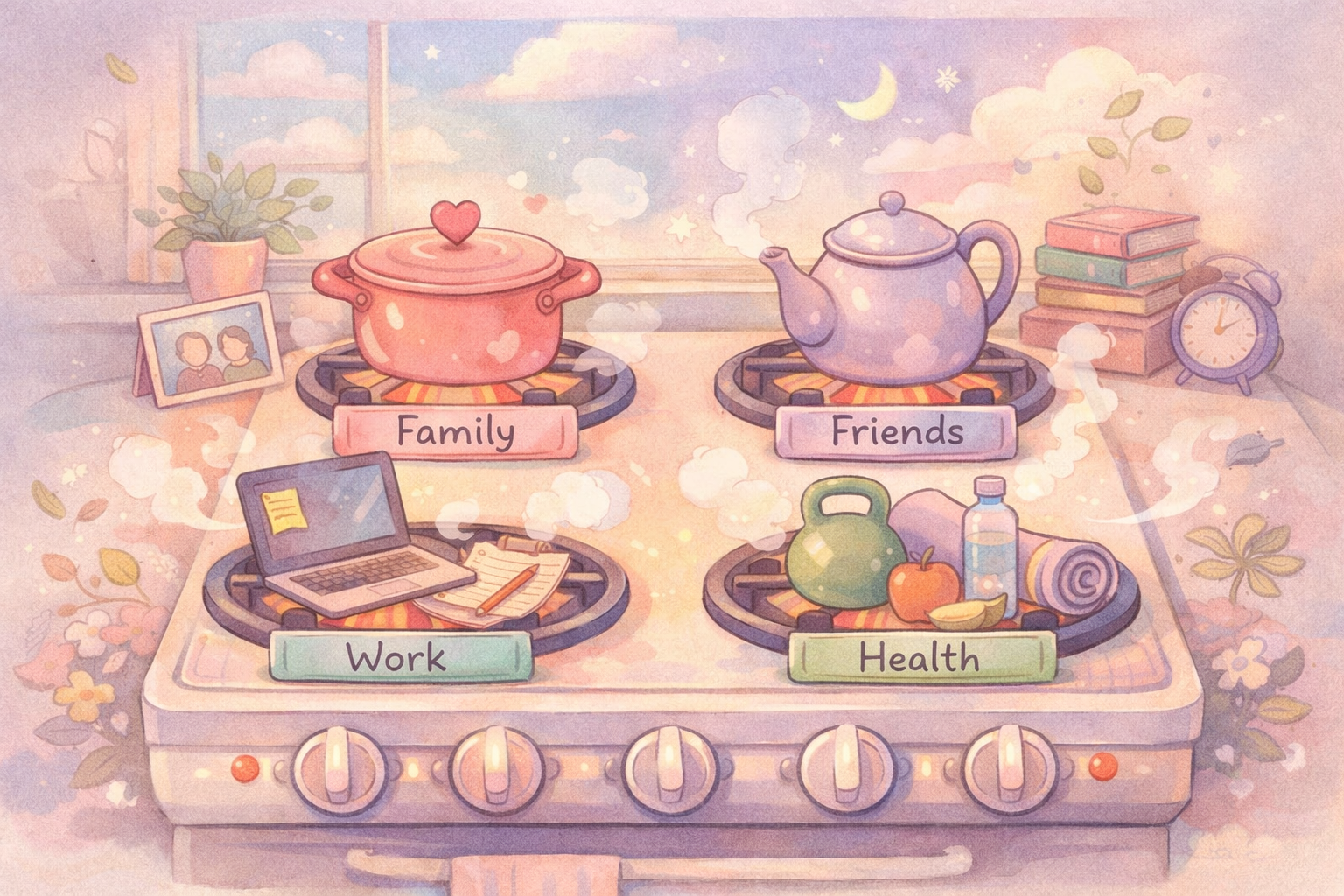
The theory was popularised by writer David Sedaris, who first heard it from a friend and shared it in an essay. The metaphor is simple: imagine your life as a stove with four burners. Each burner represents a core domain of your life- Family, Friends, Health, and Work.
The premise is blunt: in order to be successful in any of these domains, you have to cut off one burner. And in order to be really successful, you have to cut off two.
There’s no softening, no workaround offered. The theory doesn’t promise balance, it insists that extraordinary investment in one or two areas of life will almost always come at the cost of the others. And if you look honestly at the people around you who have achieved something significant, it’s hard to argue that it isn’t, at least sometimes, true.
It’s an uncomfortable framework precisely because it names something most of us quietly sense but rarely say out loud.
But I think it’s also incomplete and that’s where the science comes in.
The Neuroscience — Allostatic Load
What it doesn’t tell you is why keeping all four on full heat eventually becomes unsustainable and for that, we can turn to the neuroscience of allostatic load.
Allostasis is your brain and body’s process of maintaining stability through change. Every demand you respond to- a deadline, a social obligation, an emotional conversation, a gym session- requires your nervous system to mobilise resources. Hormones like cortisol and adrenaline are released, your prefrontal cortex works harder to regulate and plan, and your body shifts into a state of readiness.
This is healthy. This is normal. Your brain is designed to do this.
The problem isn’t the demand, it’s when demands are constant, layered, and leave no real space for recovery.
Allostatic load refers to the cumulative “wear and tear” that builds up when your system is repeatedly activated without adequate rest. Research has linked high allostatic load to cognitive impairment, emotional dysregulation, disrupted sleep, and even structural changes in the brain, particularly in the hippocampus, which is central to memory and learning, and the prefrontal cortex, which governs decision-making and impulse control.
But here’s what the theory doesn’t account for: your brain isn’t static. And neither is your life.
A New Perspective — Seasons, Not Sacrifices
The Four Burners Theory presents life as a fixed stove. You have four burners. You make a choice. You live with it.
Neuroscience tells a more dynamic story.
The brain is governed by neuroplasticity– its structure and function shift in response to where you consistently direct your energy. What you repeatedly engage with, your brain builds capacity around. What you step back from, it maintains at a lower level but doesn’t lose entirely, especially if those pathways were well-established before.
This points to something more forgiving than the original theory: life seasons. There are seasons where work demands the most heat. Seasons where family steps forward. Seasons where health becomes non-negotiable. The burners shift in intensity not because we’re failing at balance, but because we’re responding to what life is asking of us right now.
The key distinction is this: chronic suppression of a burner, driven by fear, avoidance, or unconscious neglect, creates allostatic load and erodes what you’ve built there. But intentional, temporary dialling down, with awareness and a plan to return, is a fundamentally different state for your nervous system. One feels like loss. The other feels like intentional shifts.
The question isn’t which burner do I cut off? It’s: which burner does this season need most and can I hold the others carefully enough not to lose them?
Practical Take-Aways
- Name your season honestly. What life season are you in right now? Naming it, even just to yourself, reduces the threat response your nervous system has to the burners turned lower. It becomes a choice rather than a failure.
- Maintenance mode is still a mode. Low-level engagement preserves the neural pathways you’ve built. A voice note to a friend, a short walk, a slow morning. These aren’t indulgences; they’re neurological maintenance.
- Monitor your allostatic load. Signs it’s accumulating: difficulty concentrating, disproportionate emotional reactivity, disrupted sleep, or a persistent sense of depletion. Your nervous system is asking for regulation, not more output.
- Revisit, don’t abandon. A deliberate intention to return, even a future one, reduces the psychological cost of stepping back. This chapter won’t last forever.
I think the invitation isn’t to accept sacrifice. It’s to get honest about seasons. To stop performing a version of balance that doesn’t exist, and instead tend to what needs tending now. And having faith you can come back to the others later.
The question should not be: how do I keep everything burning?
But: what does this season need and can I trust myself to come back to the rest?
I hope you enjoyed this article. Share it with anyone you feel may benefit.
Until next time,
Safiya
Want to explore this one-to-one?
Book a 30-minute chemistry call to see whether coaching is right for you, or get new articles straight to your inbox.