It’s not about real estate.
This week I’ve been doing a lot of thinking about my business, where I’m putting my energy, what’s actually worth my time, what I keep saying I’ll get to and never do.
I had a notebook open, trying to figure it out.
And somewhere in the middle of it, I stopped.
Because I realised that all this careful thinking I was doing about my business and my finances- I wasn’t applying any of it to the rest of my life. My relationships. My body. My environment. The things that make me feel like an actual human being rather than just someone with a to-do list.
I was asking all the right questions in one area, and completely ignoring them everywhere else.
Which made me wonder: what would it look like to take that same question: is what I’m investing in actually giving me something back? and apply it to everything?
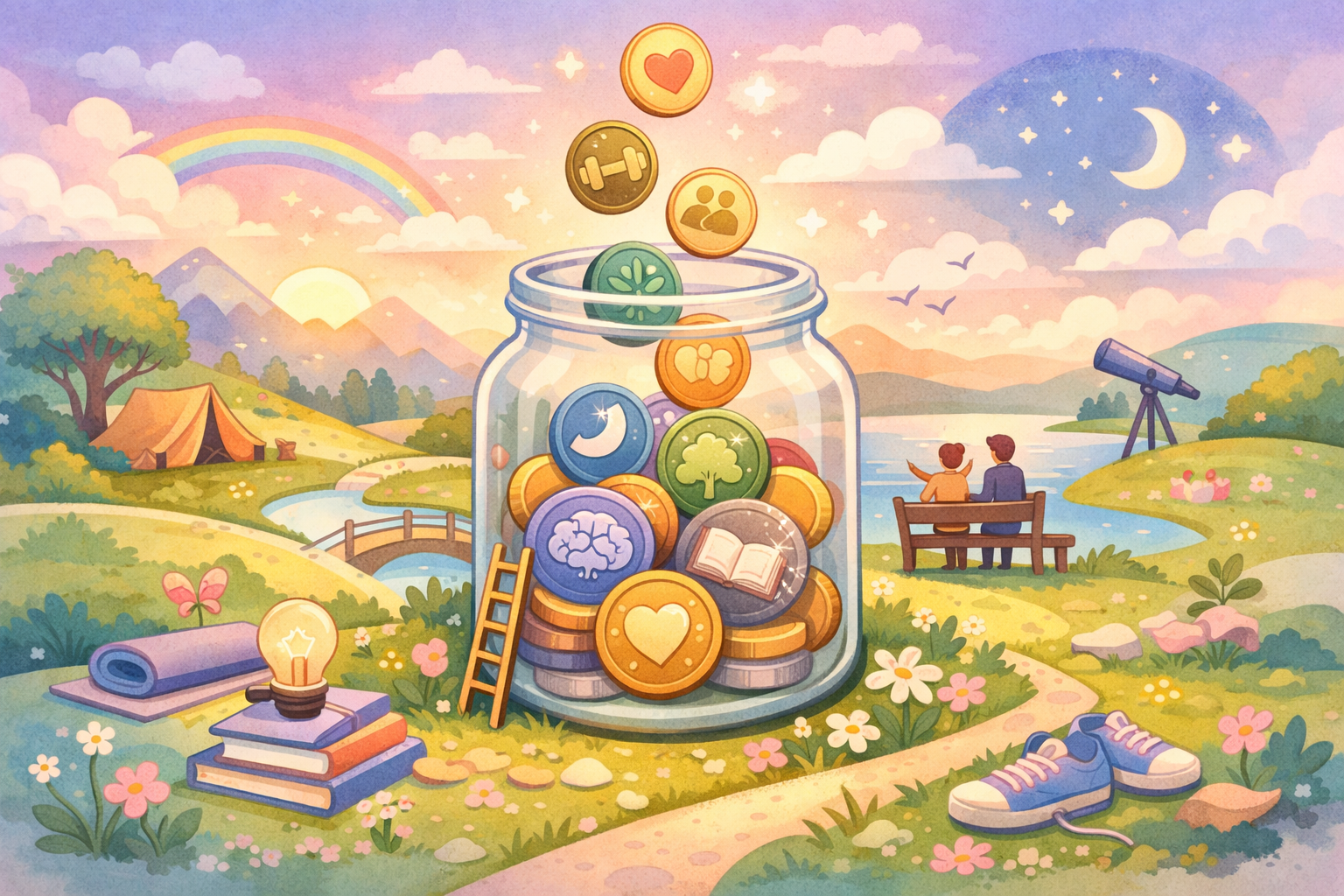
What if your life were a portfolio? And what if, for most of us, it’s catastrophically unbalanced?
The Neuroscience
Here’s something I keep coming back to: your brain doesn’t rank your experiences the way our culture does.
Financial gain, a deep conversation with someone you love, learning something that shifts how you see the world, a moment of stillness- they all activate the same reward circuitry. The brain registers: this mattered.
The idea that some investments are “real” and others are “softer” or optional. That’s not a neurological fact.
It’s a story, one we’ve been absorbing for a long time. Money, status, power are what matter, and often we quietly abandon everything else in pursuit of one or more of them.
Your Body
Think of your body as infrastructure. Deferred maintenance always costs more eventually.
Sleep is probably the most neglected one. While you’re in deep sleep, your brain’s glymphatic system– its waste disposal network- activates and clears out byproducts that build up during the day, including proteins linked to neurodegeneration. Consistently underinvesting in sleep isn’t just tiring. It’s accumulating neurological debt, quietly, every night.
And then we have physical activity, which we all know is important, but why? Movement releases BDNF, brain-derived neurotrophic factor, which supports the growth of new neurons and strengthens existing connections. The returns are real. They’re just slow. Which is exactly why it’s easy to skip.
A way you can invest in this: Pick one- an earlier bedtime this week, or one movement session you actually put in your calendar. Not both. Just one.
Your People
The anthropologist Robin Dunbar found that the human brain can meaningfully sustain around 150 relationships, with tighter circles of about 5, 15, and 50 people at different levels of closeness. This isn’t arbitrary. It reflects the actual cognitive load of maintaining genuine bonds.
And those bonds aren’t a luxury. They’re load-bearing.
Loneliness has measurable physiological effects- elevated cortisol, increased inflammation, disrupted sleep. Close relationships, by contrast, genuinely buffer the stress response. People with strong social connections recover from difficulty faster. They live longer.
Your five closest people are one of the most significant investments you’ll ever make. When did you last show up for them?
A way you can invest in this: Think of one person you’ve been meaning to reach out to. Send the message today- not a long one, just something that says I’m thinking of you.
Your Mind
Every time you genuinely engage with something new, you’re physically changing your brain- neurons begin forming connections, pathways strengthening through a process called myelination. There’s also something called cognitive reserve, the brain’s resilience built up through a lifetime of learning, which means the investment compounds in ways you can’t always see.
But beyond the neuroscience, there’s something simpler: understanding changes what’s possible for you. It expands your frame, gives you more language, more capacity to make sense of your experience. No one can take that from you.
A way you can invest in this: Give yourself 20 minutes this week with something that genuinely interests you- a book, a documentary, a podcast, a conversation with someone who thinks differently to you.
Your Inner Life
Whatever form it takes for you- faith, meditation, time in nature, creativity, sitting with hard questions- the neurological signature is remarkably consistent. These practices reduce reactivity in the amygdala, the brain’s threat-detection centre. They’re linked to increased grey matter in the prefrontal cortex, the region responsible for emotional regulation and perspective. And they’re associated with what researchers call eudaimonic wellbeing: not just feeling good, but feeling like your life means something.
In a world that is relentlessly loud, that kind of stillness isn’t indulgent. It’s protective.
A way you can invest in this: Find ten minutes this week with no input — no phone, no podcast, no noise. Just you and whatever comes up.
Your Environment
The spaces we inhabit shape us more than we tend to acknowledge. Research on environmental psychology shows that clutter and visual noise increase cortisol and deplete cognitive resources, your brain is working in the background to process everything around you, even when you’re not aware of it. Light, sound, temperature, and the objects you surround yourself with all influence mood, focus, and nervous system regulation in ways that are measurable.
This extends to your digital environment too. The content you consume daily, the accounts you follow, the group chats you’re in, these aren’t neutral. They’re inputs your brain is constantly processing and responding to.
A way you can invest in this: Pick one space you spend a lot of time in and make one small change- tidy a surface, add something living, or mute the thing that consistently drains you.
I hope you enjoyed this article. Share it with anyone you feel may benefit.
Until next time,
Safiya
Want to explore this one-to-one?
Book a 30-minute chemistry call to see whether coaching is right for you, or get new articles straight to your inbox.