
What it actually takes, neurologically, to hold space for someone else.
This past month has been a period of transition for my family, especially my kids. It has brought up an array and spectrum of emotions and I have spent the past few months trying to fix it, explain it, overthink it, make it easier. Mostly what I got back was just a feeling of exhaustion.
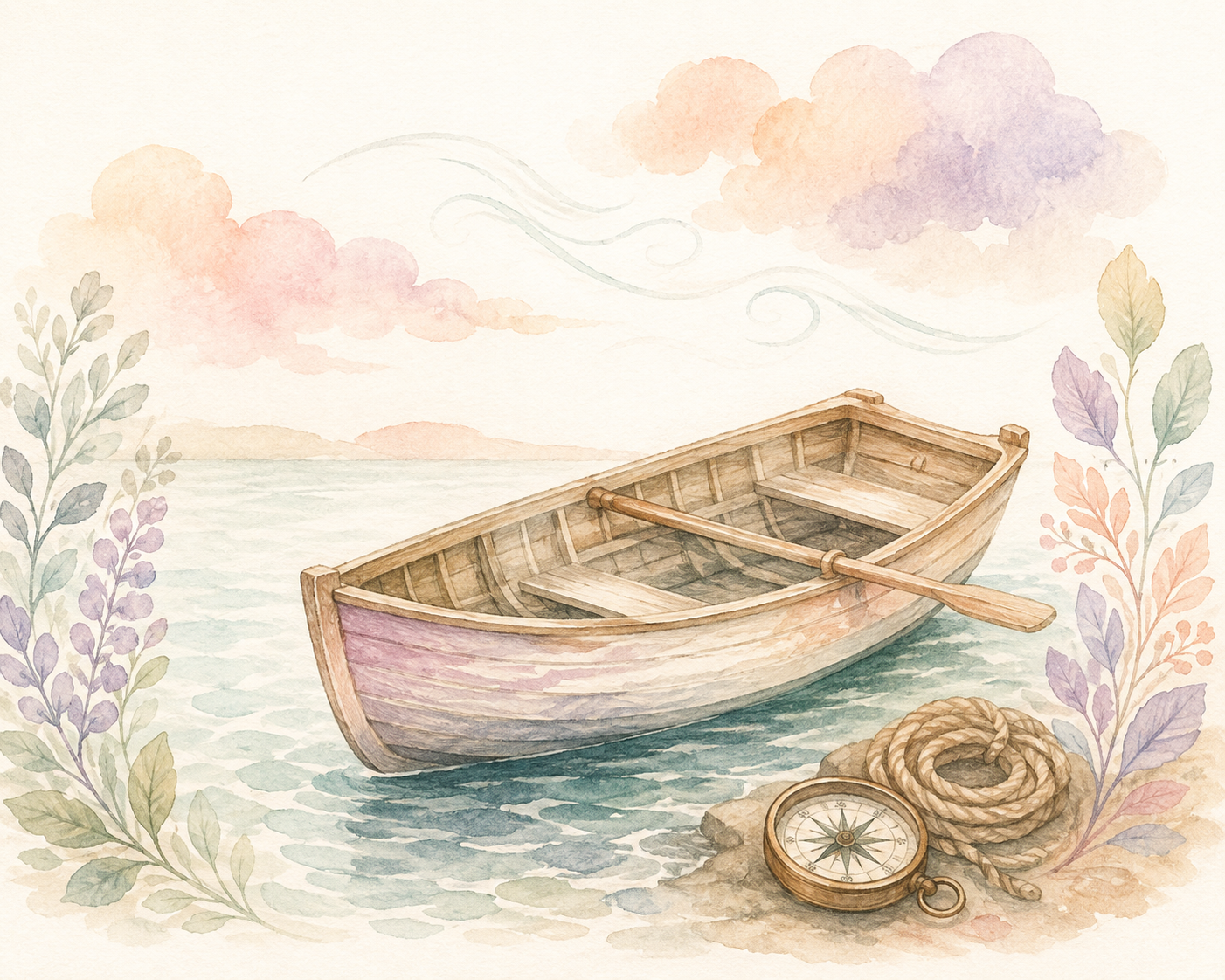
Then in a coaching session this week, my coach said: “You don’t need to fix the storm. You need to be the boat.”
I didn’t say much back. I just sat with it. Because it named something I’d been doing ineffectively, or not at all: staying steady near someone else’s weather, rather than trying to stop it from raining.
I’ve been sitting with that image. The boat.
The longer I thought about it, the more it stopped being one image and started being several.
A boat in a storm isn’t doing one job. There’s the hull, which simply has to stay afloat and watertight, so someone has somewhere to be. There’s whoever is at the helm, still making calls when the person beside them can’t make any of their own. There’s the storm itself, the wind and the water, which someone aboard still has to feel, even from inside a boat that isn’t going down. And there’s the compass, unbothered by the weather, still quietly pointing somewhere, hopefully in the right direction.
Once I saw it that way, I recognised each role separately in what I’d been doing for my kids these past months. Some days I was only the hull. Some days I was making every decision because they couldn’t. Some days I let the storm reach me too, right alongside them. And some days, the only useful thing I had to give was a sense of which way was up.
So that’s the shape this piece follows. Not holding space as one undifferentiated act of love, but as four distinct roles: the boat, the captain, the waves and wind, the compass- each with its own function, its own cost, and, it turns out, its own neuroscience.
The Four Roles of Holding Space

When someone you love is dysregulated: a child mid-meltdown, a parent mid-crisis, a friend mid-collapse- their nervous system is, quite literally, reading yours. Porges calls this neuroception: a below-conscious scanning system that is constantly asking, beneath language, is it safe here?
The Boat
When you stay steady near someone who isn’t, your regulated state becomes information their body can borrow. This is co-regulation. A well-known study by Coan found that simply holding the hand of someone calm and trusted measurably lowered a person’s threat response under stress- before either of them said a word. That is the boat: not fixing the storm, just staying afloat near it so someone else can hold on.
The Captain
The captain is a different function. It’s the part of you that keeps deciding — what happens next, what’s safe, what needs to wait — when the other person’s own decision-making has gone offline under stress. You’re not steering their feelings. You’re holding the practical helm so they don’t also have to navigate while they’re underwater.
The Waves and Wind
The waves and wind are empathy, properly defined: not comfort, but resonance. Singer and Klimecki’s work found that empathy activates the same neural circuitry: the anterior insula, the anterior cingulate- that fires when you’re in pain yourself. That overlap is not a flaw. It’s what makes you able to feel that something matters to someone else. But it is also, unmanaged, the part that can capsize you.
The Compass
The compass is what tends to get skipped. It’s the part of you that can see further than the person in the middle of the storm- not steering them, but reflecting back a sense of direction. This draws on a more cognitive kind of understanding others, sometimes called mentalising, and it runs on largely separate circuitry from the empathic, feeling-with part. You can offer a compass without ever taking someone’s hand off the wheel.
Feeling With vs. Feeling For
Holding space has a cost, and the cost is not evenly distributed across these four roles.
Singer and Klimecki’s research drew a sharp line between empathy and compassion. When people were trained to empathise more deeply with suffering, their distress went up and their own wellbeing went down- the brain stayed locked in that shared-pain circuitry. When the same people were then trained in compassion instead- a warmer, more resourced feeling for rather than feeling with– their distress reversed, and an entirely different network lit up, one linked to reward and connection rather than pain.
The distinction matters because it tells you where burnout actually comes from. It is rarely the boat, the captain, or the compass that empties you. It is staying in the waves and wind long after you were needed there, matching someone’s storm instead of remaining near it.
Four Ways to Hold Space Without Losing Yourself
- Ask which role is actually needed. Before you pour everything in, notice what’s missing for the other person right now: steadiness, decisions, feeling understood, or direction. You rarely need to supply all four at once, and reaching for the wrong one is its own kind of exhausting.
- Regulate before you board. You cannot lend a nervous system you haven’t steadied yourself. A breath, a pause, both feet on the floor before you walk into someone else’s storm.
- Leave them a hand on the wheel. Holding space isn’t the same as taking over. Where you can, let the other person keep making the small decisions still available to them. Agency, even in distress, is regulating in itself.
- Know your own harbour. Even the sturdiest boat needs dry dock. Notice who or what re-steadies you after you’ve steadied someone else, and treat that as maintenance, not indulgence.
A Thought to Sit With
Nobody warns you that holding space is a physical act as much as an emotional one- your body is doing real work when you stay calm next to someone else’s chaos.
The boat doesn’t stop the storm. It was never meant to. It just stays afloat, so someone else has somewhere to be while the weather passes.
That is not a small thing. It might be one of the most important things you do for the people you love.
Reflection Questions
Which role: boat, captain, waves and wind, or compass- do you default to, whether or not it’s the one that’s needed?
Where in your life have you stayed in the storm with someone long after they needed you to be the calm instead?
Who or what is your own harbour and when did you last actually let yourself dock there?
I hope you enjoyed this article. Share it with anyone you feel may benefit.
Until next time,
Safiya
Want to explore this one-to-one?
Book a 30-minute chemistry call to see whether coaching is right for you, or get new articles straight to your inbox.