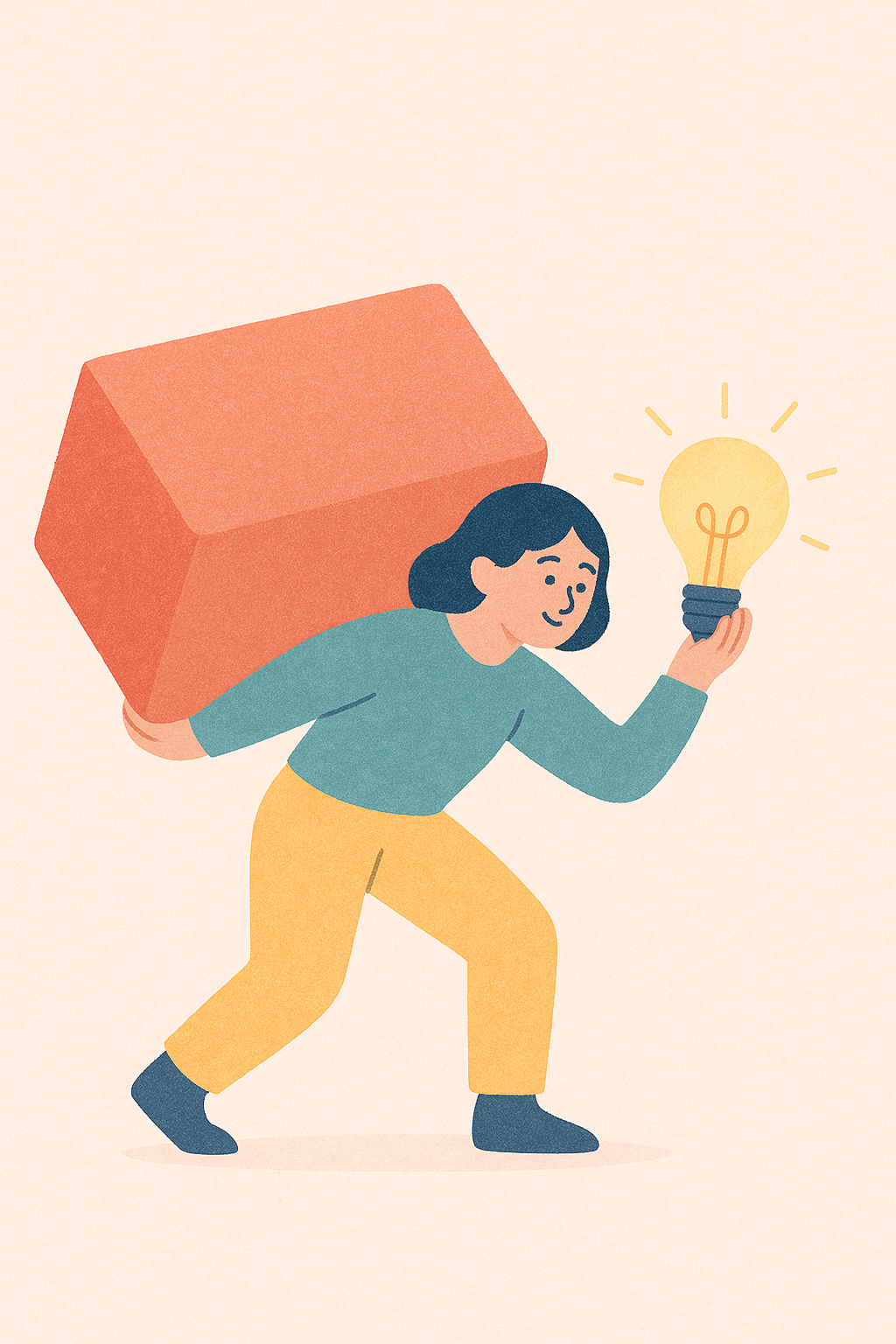
Some things are objectively hard, yet the experience of doing them can feel lighter or heavier depending on what’s happening inside our brain.
This morning, while listening to a voice note from a friend, she said something which got me thinking:
“A life in academia is tough.”
She said it with that kind of tired honesty that only comes from someone living it day after day. And as I heard her, I remembered that I used to say the same thing about coaching. It was tough. It is tough. And so many of the things we choose to do feel heavy in exactly the same way. It could be parenting, studying, building something from scratch, focusing on your health or a new project at work.
Some things are objectively hard, yet the experience of doing them can feel lighter or heavier depending on what’s happening inside our brain.
So I started to think about what makes the tough stuff a bit easier…
Remembering Your “Why” is not cliché- it’s neurological
When you connect what you’re doing to a deeper reason your brain activates networks linked to intrinsic motivation. These systems release dopamine before the outcome, not after, making effort feel less like a drain and more like a direction.
Your “why” turns the same task from:
“I have to do this” → “I choose to do this.”
That shift matters more than we think.
Reflecting on Your Journey
When you pause and ask, How did I get here? You are activating your brain’s autobiographical memory– the system that builds your experiences into a narrative. It is strongly related to self-perception and self representation.
Narratives create meaning.
Meaning reduces stress.
And stress reduction increases cognitive flexibility- the part of your brain that helps you keep going.
Remembering the steps you took to arrive here doesn’t make the present moment easier, but it does make it feel more grounded.
You’re not struggling in isolation; you’re continuing a story.
Organisation and structure reduce cognitive load
Sometimes hard things feel heavy simply because our brain is juggling too many open tabs.
Organisation doesn’t make the work “less hard.”
But it does reduce cognitive load, increasing our ability to make decisions clearly.
Every small system (a planner, a timetable, a step-by-step breakdown) frees up neural resources for actual thinking, not just managing.
This is why qualifications, experience, and routines matter: they create predictability, and predictability calms the brain.
Coaching Reflection
Hard seasons don’t always get lighter because the work changes.
Sometimes they get lighter because you change.
Because you understand yourself more deeply.
Because your narrative becomes stronger.
Because your brain becomes better at holding the weight.
If you’re in a tough chapter right now, ask yourself:
What will make the weight easier to carry?
I hope you enjoyed this article. Share it with anyone you feel may benefit.
Until next time,
Safiya
Want to explore this one-to-one?
Book a 30-minute chemistry call to see whether coaching is right for you, or get new articles straight to your inbox.