The science of heredity: what we inherit, and how much of it we can change.
I recently came across a book called She Has Her Mother’s Laugh by Carl Zimmer, and it got me thinking about something we say all the time.
“He laughs just like his grandfather.”
“That definitely runs in the family.”
We often talk about the things we inherit as though they’re fixed parts of who we are. But how much of what we inherit comes from our genes, and how much comes from the environment we grow up in?
And perhaps more importantly, how much of it can we change?
More Than Our Genes
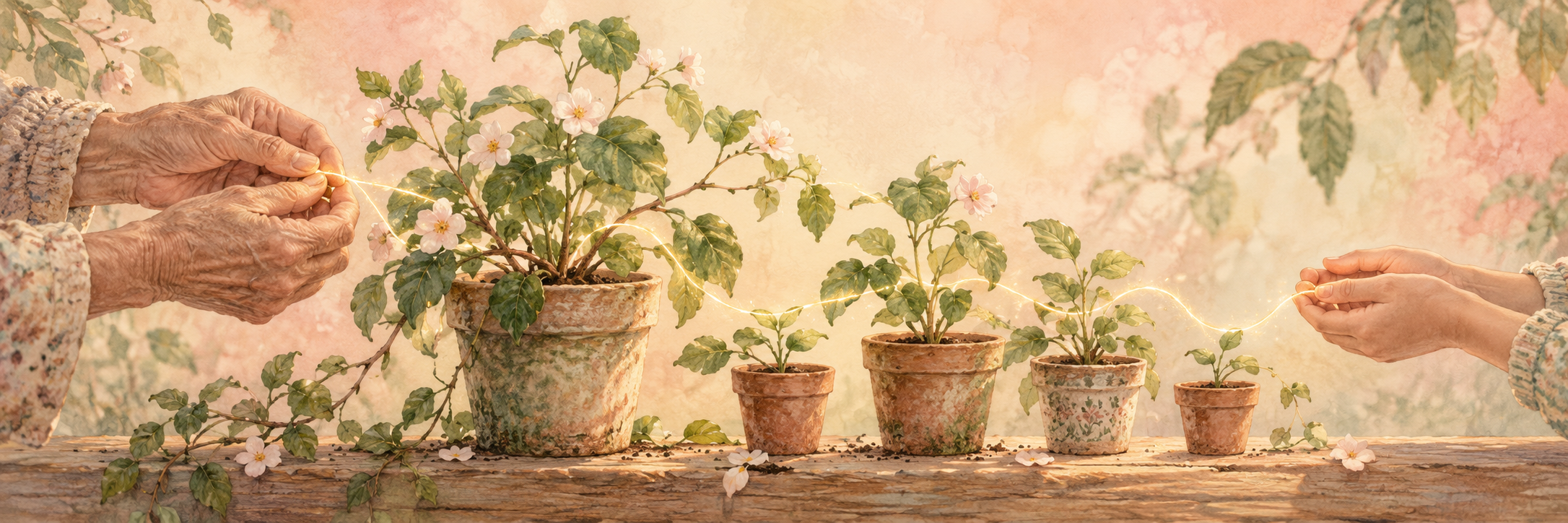
One of the ideas Zimmer explores in his book is that heredity goes far beyond DNA.
Of course, we inherit genetic information from our parents. But we also pick up habits, beliefs, traditions and ways of responding to the world.
Think about how your family dealt with disagreements. Was conflict discussed openly, or was it avoided? What happened when someone made a mistake? How was affection expressed?
We learn so much of this without anyone explicitly teaching us.
As children, we observe the people around us, and over time, some of those behaviours become our own.
So when we say someone is just like their mother or father, we may be noticing a combination of genetic influences and behaviours they’ve learned over years of growing up together.
And often, we don’t even realise which is which.
What Do We Inherit?
When we think about genetics, physical characteristics are usually the first things that come to mind. Eye colour, hair colour, height and facial features. But our genes influence far more than how we look.
We can also inherit genetic predispositions that influence aspects of our temperament, personality, cognitive abilities and susceptibility to certain physical and mental health conditions.
For example, research suggests that traits such as extraversion, emotional sensitivity and impulsivity have a genetic component. Some people may naturally be more cautious, while others are more inclined towards novelty or risk-taking.
But most of these characteristics are complex traits, influenced by many genes rather than a single gene determining a particular outcome. And genes are not the only influence.
How Much of Who We Are Is Genetic?
This brings us to an important question: If certain personality traits, behaviours or emotional tendencies run in families, does that mean we’re destined to have them too?
Consider anxiety. Having a family history of anxiety disorders may increase someone’s likelihood of experiencing anxiety themselves. But it doesn’t mean they inevitably will.
A large review by Polderman and colleagues, looking at fifty years of twin studies, estimated that genetic differences account for approximately half of the variation across the human traits studied.
When scientists describe a trait as 50% heritable, they don’t mean that 50% of an individual’s personality or behaviour is determined by their genes.
Heritability is a population-level measure. It tells us how much of the variation between people, in a particular population and environment, is associated with genetic differences.
It doesn’t tell us how much of you is fixed.
Take height, for example. Height is highly heritable, yet average heights have increased substantially in many populations over the last century, partly because of improvements in nutrition and health. The genetic makeup didn’t suddenly change. The environment did.
The Role of Epigenetics
You may have come across the term epigenetics.
Epigenetics refers to biological processes that help regulate how our genes are used, without changing the underlying DNA sequence.
One way to think about it is that our DNA provides the instructions, while epigenetic mechanisms help influence which instructions are used, when and to what extent.
These processes can be influenced by factors such as development, ageing, nutrition and environmental exposures.
Type 2 diabetes is a good example. It tends to run in families, and having a parent with it raises your own risk. But diet, physical activity, sleep and stress all affect how the body handles sugar, and some of that influence works through epigenetic changes. In the Diabetes Prevention Program, a large US trial, people at high risk who made modest lifestyle changes cut their chances of developing the condition by more than half.
That doesn’t mean anyone who develops it has done something wrong. Many factors are outside our control. But a genetic risk isn’t a diagnosis. It’s one part of the picture, and how we live is another.
What Does This Mean for Us?
We may inherit certain predispositions, but we also develop patterns through experience.
Perhaps you grew up in a family where worrying was normal, where emotions weren’t discussed, or where making mistakes was something to be embarrassed about.
You might find yourself responding in similar ways as an adult, even when those responses no longer serve you.
But just because a response feels automatic doesn’t mean it’s necessarily permanent.
Our brains retain the capacity to learn and adapt throughout life, a property known as neuroplasticity.
With awareness, practice and repetition, we can develop different ways of responding.
Of course, this doesn’t mean that every tendency can be changed simply by deciding to change it. Biology, circumstances and past experiences all play a role.
But it does mean that our past doesn’t have to dictate every response we make in the future.
And I think there’s something equally important here: not everything we inherit needs changing.
Some of the things we pick up from our families are wonderful. A sense of humour, generosity, resilience, curiosity, or a particular way of making people feel welcome.
These are things worth recognising and carrying forward.
A Few Things to Try This Week
Rather than focusing only on the habits you’d like to change, spend a little time noticing what you’ve inherited.
- Notice a familiar pattern. Is there a particular reaction, belief or habit that reminds you of someone you grew up around? Think about whether it’s something you want to continue or something you’d like to approach differently.
- Recognise what you value. What qualities or traditions have you picked up from your family that you’re grateful for? We often spend more time thinking about what we’d like to change than appreciating what we’d like to keep.
- Think about what you’re passing on. Whether it’s to your children, friends, colleagues or the people you interact with every day, consider the behaviours and attitudes others might be learning from you.
A Final Thought
We don’t get to choose our genes or the environment we’re born into and we may not even realise how much of our behaviour has been shaped by the people around us.
But as we become more aware of these influences, we can begin to make more intentional choices about which patterns we continue and which ones we want to change.
I hope you enjoyed this article. Share it with anyone you feel may benefit.
Until next time,
Safiya
Want to explore this one-to-one?
Book a 30-minute chemistry call to see whether coaching is right for you, or get new articles straight to your inbox.